Types of Color Blindness: Protan, Deutan, Tritan Explained
The three main types, what each one makes hard to see, how common they are and what causes them, with simulated examples.
This is a screening tool, not a medical diagnosis. Results depend on your screen, brightness and lighting. See an eye doctor for a proper exam. Medical disclaimer
Last updated: . Based on the sources listed below.
What are the types of color blindness?
| Type | What is hard to tell apart | How common (source) |
|---|---|---|
| Deuteranomaly | Certain greens look more red. The most common red-green type, mild. | Red-green types together: about 1 in 12 males and 1 in 200 females among people of Northern European ancestry; lower in almost all other populations studied (MedlinePlus Genetics) |
| Protanomaly | Certain reds look more green and less bright. Mild. | |
| Deuteranopia | Red and green cannot be told apart at all. | |
| Protanopia | Red and green cannot be told apart at all. | |
| Tritanomaly | Blue and green, and yellow and red, are hard to tell apart. | Blue-yellow defects: fewer than 1 in 10,000 people worldwide, males and females equally (MedlinePlus Genetics) |
| Tritanopia | Blue and green, purple and red, and yellow and pink cannot be told apart; colors look less bright. | |
| Monochromacy (achromatopsia) | No color is seen. Depending on the type there may also be poor sharpness and light sensitivity. | Blue cone monochromacy, a related form: about 1 in 100,000 people worldwide (MedlinePlus Genetics) |
Sources: NEI: Types of Color Vision Deficiency, MedlinePlus Genetics. The sources do not give separate frequencies for protan and deutan types, so we do not either.
What does color blindness look like? Simulated examples
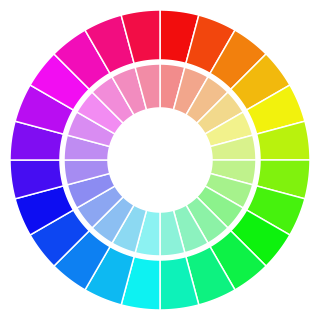
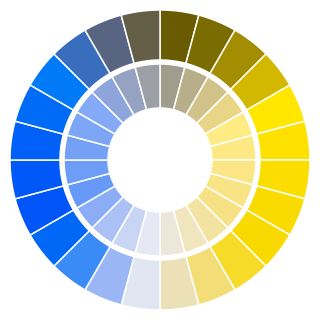
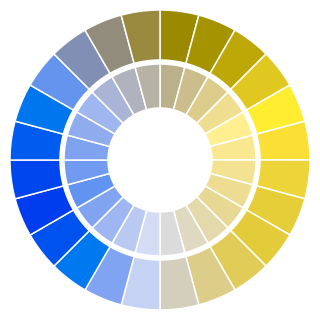
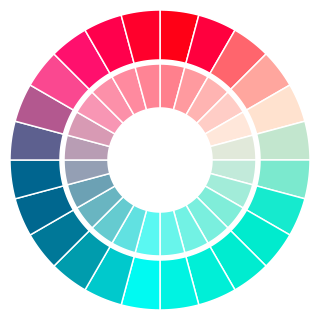
These color wheels were made by our own code with the Machado et al. (2009) model of dichromat vision (Machado, Oliveira & Fernandes). They show complete loss of one cone type, the “-opia” types. The “-anomaly” types are milder, so they look less different. People also differ a lot, and nobody can see exactly through another person’s eyes, so treat these as an approximation.
What causes color blindness?
Most people who have color vision deficiency are born with it, because the most common types are genetic (National Eye Institute: Color Blindness). Red-green types are passed on through the X chromosome, which is why they are more common in men: a male has one X chromosome, while a female needs the gene on both (NEI: Causes of Color Vision Deficiency). Blue-yellow types involve other chromosomes and affect both sexes equally.
It can also start later, from eye diseases such as glaucoma or macular degeneration, brain and nervous system diseases, some medicines, or injuries, and color vision may worsen with age, especially with cataracts (NEI: Causes of Color Vision Deficiency). The American Academy of Ophthalmology says anyone with a significant change in color perception should see an ophthalmologist.
How do I find out which type I have?
Only an eye care professional can tell you. A common test shows a circle made of many colored dots with a shape inside that is hard to see if you have color vision deficiency (National Eye Institute: Color Blindness). Our free color blind test works like that and can show signs, but it cannot name your type with confidence. There is no cure for inherited color vision deficiency, but most people adjust, and special glasses or contacts may help some people tell colors apart (National Eye Institute: Color Blindness, AAO: Do Colorblindness Glasses Really Work?).
Frequently asked questions
What is the difference between protan and deutan?
Both are red-green types. Protanomaly makes certain shades of red look more green and less bright, while deuteranomaly makes certain shades of green look more red. Protanopia and deuteranopia both mean no ability to tell red from green. A screen test cannot reliably tell the types apart.
What is tritanopia, or blue-yellow color blindness?
Tritanopia is a rare blue-yellow type. The National Eye Institute says it makes someone unable to tell blue from green, purple from red, and yellow from pink, and colors look less bright. MedlinePlus Genetics says blue-yellow defects affect fewer than 1 in 10,000 people worldwide.
What is total color blindness?
Complete color vision deficiency, also called monochromacy or achromatopsia, means not seeing colors at all. The National Eye Institute calls it rare, and depending on the type there may also be trouble seeing clearly and more sensitivity to light. Blue cone monochromacy affects about 1 in 100,000 people, says MedlinePlus Genetics.
How common is color blindness?
The National Eye Institute says about 1 in 12 men have color vision deficiency. MedlinePlus Genetics reports red-green types in about 1 in 12 males and 1 in 200 females among people of Northern European ancestry, with lower rates in almost all other populations studied.
Can women be color blind?
Yes, but it is much rarer. MedlinePlus Genetics gives about 1 in 200 females for red-green types among people of Northern European ancestry, compared with about 1 in 12 males. Blue-yellow color vision deficiency affects males and females equally.
Does color blindness affect how sharp my vision is?
Usually not. MedlinePlus Genetics says red-green and blue-yellow defects do not affect sharpness of vision, and the American Academy of Ophthalmology says sharpness is unaffected except in the most severe form. Complete color blindness can come with poor vision, light sensitivity and involuntary eye movements.
Sources
- National Eye Institute (NIH). Types of Color Vision Deficiency. Last updated August 7, 2023. https://www.nei.nih.gov/learn-about-eye-health/eye-conditions-and-diseases/color-blindness/types-color-vision-deficiency
- MedlinePlus Genetics (U.S. National Library of Medicine). Color vision deficiency. https://medlineplus.gov/genetics/condition/color-vision-deficiency/
- National Eye Institute (NIH). Color Blindness. Last updated November 5, 2025. https://www.nei.nih.gov/learn-about-eye-health/eye-conditions-and-diseases/color-blindness
- National Eye Institute (NIH). Causes of Color Vision Deficiency. Last updated January 30, 2025. https://www.nei.nih.gov/learn-about-eye-health/eye-conditions-and-diseases/color-blindness/causes-color-vision-deficiency
- American Academy of Ophthalmology. What Is Color Blindness? Published July 2, 2026; reviewed by Cesar A Briceno, MD. https://www.aao.org/eye-health/diseases/what-is-color-blindness
- American Academy of Ophthalmology. Do Colorblindness Glasses Really Work? Published March 8, 2021; reviewed by Ivan R Schwab, MD and Laurie Gray Barber, MD. https://www.aao.org/eye-health/tips-prevention/do-color-blindness-correcting-glasses-work
- Machado GM, Oliveira MM, Fernandes LAF. A Physiologically-Based Model for Simulation of Color Vision Deficiency. IEEE Trans Vis Comput Graph. 2009;15(6):1291-1298. https://doi.org/10.1109/TVCG.2009.113
All sources were read on October 11, 2026. We only state what the sources say, and we do not invent numbers. These pages have not been reviewed by an eye care professional. Spot a mistake? Email info@colorblindcheck.app.